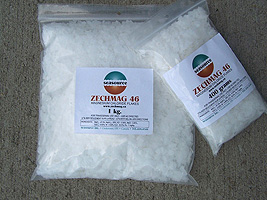
ProductSource and History Themagnesium salt used for the ZECHMAG products are sourced from theZechstein Sea. This sea, 250 million years ago, occupied the region ofwhat is now the North Sea plus the lowland areas of Britain and thenorth European plain through the Netherlands, Germany and Poland.Through evaporation and earth movements, the water in the seadisappeared and the salt was covered, creating the deep undergrounddeposits. That is why the magnesium chloride salt from this source isso pure. It has never been in contact with the modern day environmentand has no impurities such as acid rain and heavy metals found insurface seawater. The type of salt found here is called BISCHOFITE.This is a saline evaporite, consisting of Magnesium Chloride with theformula MgCI2-6H20. This very high quality type of magnesium salt wasdiscovered by Karl Gustav Bischof (1792-1870) a German geologist andmineral chemist at the University of Bonn in Germany.
Some History on the use of MagnesiumChloride (excerpts from aarticle by Dr. Raul Vergini, MD) Backin 1915, a French surgeon, Prof. Pierre Delbet,MD, was looking for asolution to cleanse wounds, because he had found out that thetraditional antiseptic solutions actually mortified tissues andfacilitated the infection instead of preventing it.
Hetestedseveral mineral solutions and discovered that a Magnesium Chloridesolution was not only harmless for tissues, but it had also a greateffect over leucocytic activity and phagocytosis; so it was perfect forexternal wounds treatment.
Dr.Delbet performed a lotof "invitro" and "in vivo" experiments with this solution and he became awarethat it was good not only for external applications, but it was also apowerful immuno-stimulant if taken by injections or even by mouth. Hecalled this effect "cytophilaxis". In some "in vivo" experiments it wasable to increase phagocytosis rate up to 300%.
Dr.Delbetserendipitously discovered that this oral solution had also a toniceffect on many people and so became aware that the Magnesium Chloridehad an effect on the whole organism. In a brief time, he receivedcommunications of very good therapeutics effects of this "therapy" frompeople that were taking Magnesium Chloride for its tonic properties andwho were suffering from various ailments. Prof.Delbet began to closelystudy the subject and verified that the Magnesium Chloride solution wasa very good therapy for a long list of diseases.
In1943 anotherFrench doctor, A.Neveu,MD, used the Magnesium Chloride solution in acase of diphteria to reduce the risks of anaphylactic reaction due tothe anti-diphteric serum that he was ready to administer. To his greatsurprise, when the next day the laboratory results confirmed thediagnosis of diphteria, the little girl was completely cured, before hecould use the serum.
He credited theimmuno-stimulant activityto the solution for this result, and he tested it in some otherdiphteric patients. All the patients were cured in a very short time(24-48 hours), with no after-effects.
As MagnesiumChloride hasno direct effect on bacteria (i.e.it is not an antibiotic), Neveuthought that its action was aspecific, immuno-enhancing, so it could beuseful, in the same manner, also against viral diseases. So he began totreat some cases of poliomyelitis, and had the same wonderful results.
Butthe indications for Magnesium Chloride therapy don't end here. In morerecent years other physicians have verified many of Delbet's andNeveu's applications and have tried the therapy in other pathologies:asthmatic acute attack, shock, tetanus (for these the solution isadministered by intravenous injection); herpes zoster, acute andchronic conjunctivitis, optic neuritis, rheumatic diseases, manyallergic diseases, spring- asthenia and Chronic Fatigue Syndrome (evenin cancer it can be an useful adjuvant.
From apracticalstandpoint, please remember that only Magnesium CHLORIDE has this"cytophilactic" activity, and no other magnesium salt; probably it's amolecular, and not a merely ionic, matter.
Historyon the Magnesium Chloride sourced from the underground Zechstein Sea Inthe late 70”s, while drilling for natural gas in the northernprovince of Groningen, Shell discovered the layer of mineral bischofite.
In1979, Shell and Billiton formed a company. A mining operation wasdeveloped together with a processing facility and production started in1981
In 1994 the company was sold and changed nameswith the newowners working on improving the mining technology and getting a higherquality product.
In 2001 Calcium Chloride was addedto theproduct mix and the improved mining and processing systems improved thequality of the salts.
In 2004 the company becameaware of thetransdermal application possibility and their efforts were quicklyrecognized by the health sector as very beneficial for humansupplementation and dealing with the magnesium deficiency found in somany people.
Health professionals throughout theworld havebecome aware of the many advantages of transdermal application ofMagnesium Chloride and in 2007 Dr. Mark Sircus, AC., O.M.D. wrote thebook “TRANSDERMAL MAGNESIUM THERAPY,” that is fastbecominga best seller.
Quick Facts on ZechsteinMagnesium Chloride Deposits: * The formation of magnesium chloride from the ancient Zechstein Sea isover 250 million years old. * The disappearance of the once active Zechstein Sea into an inactivesubterranean geological formation is due to a general marine regressionthat accompanied the most severe extinction event in the history ofEarth – known as the Permian-Triassic extinction event. * Zechstein magnesium chloride deposits are mined approximately 2kilometers beneath the surface of the earth. *The Zechstein Sea was located in the Northern part of Europe, in theEuropean Permian Basin, extending from the eastern coast of England toNorthern Poland. * The AncientZechstein Sea hasbeen kept unadulterated from modern contaminants for the past 250million years due to deep subterranean isolation. * The term “Zechstein” is German for“toughstone,” yet also corresponds to a unit of time in thegeologictimetable. * Zechsteinmagnesium salts are directly extracted from the earth by a processknown as solution mining.